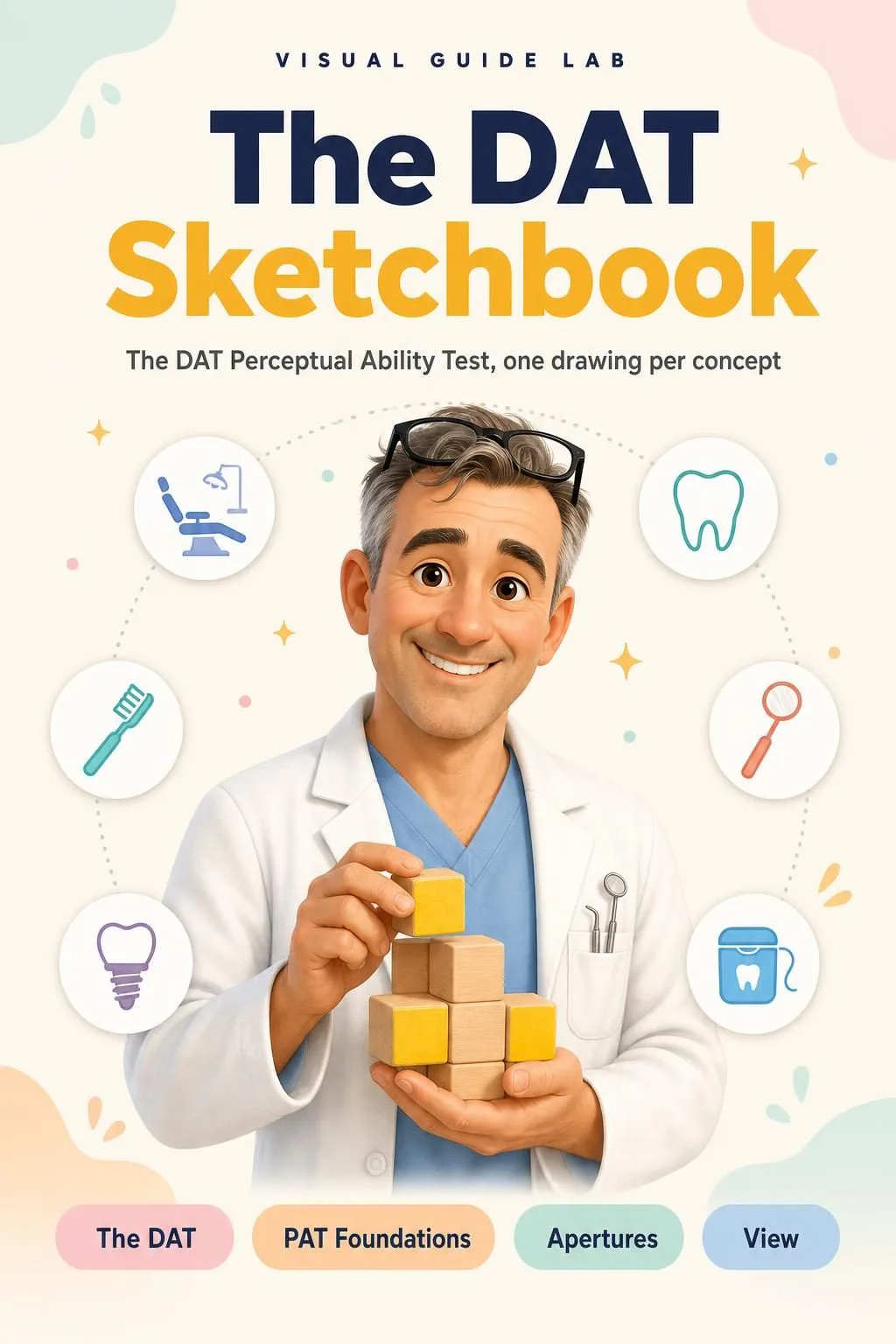
Apertures, views, angles, paper folding, cube counting and cube nets: most prep gives you a paragraph of rules and a hundred drills. Here each subtest is a drawn check on one page, plus biology, chemistry, reading and math, one page per topic. 65 illustrated pages.
🔒 Secure checkout · PDF by email · 30-day guarantee
One topic per page: a drawing that shows you how it's done, and boxes with what you need to know:


Swipe to see more →
These are real pages from the book. The table of contents is the full one: 11 parts and 61 topics.
You've read the aperture instructions three times. You close your notes...
...and you can't remember if you're allowed to turn the object once it starts through the opening. It was just a block of text.

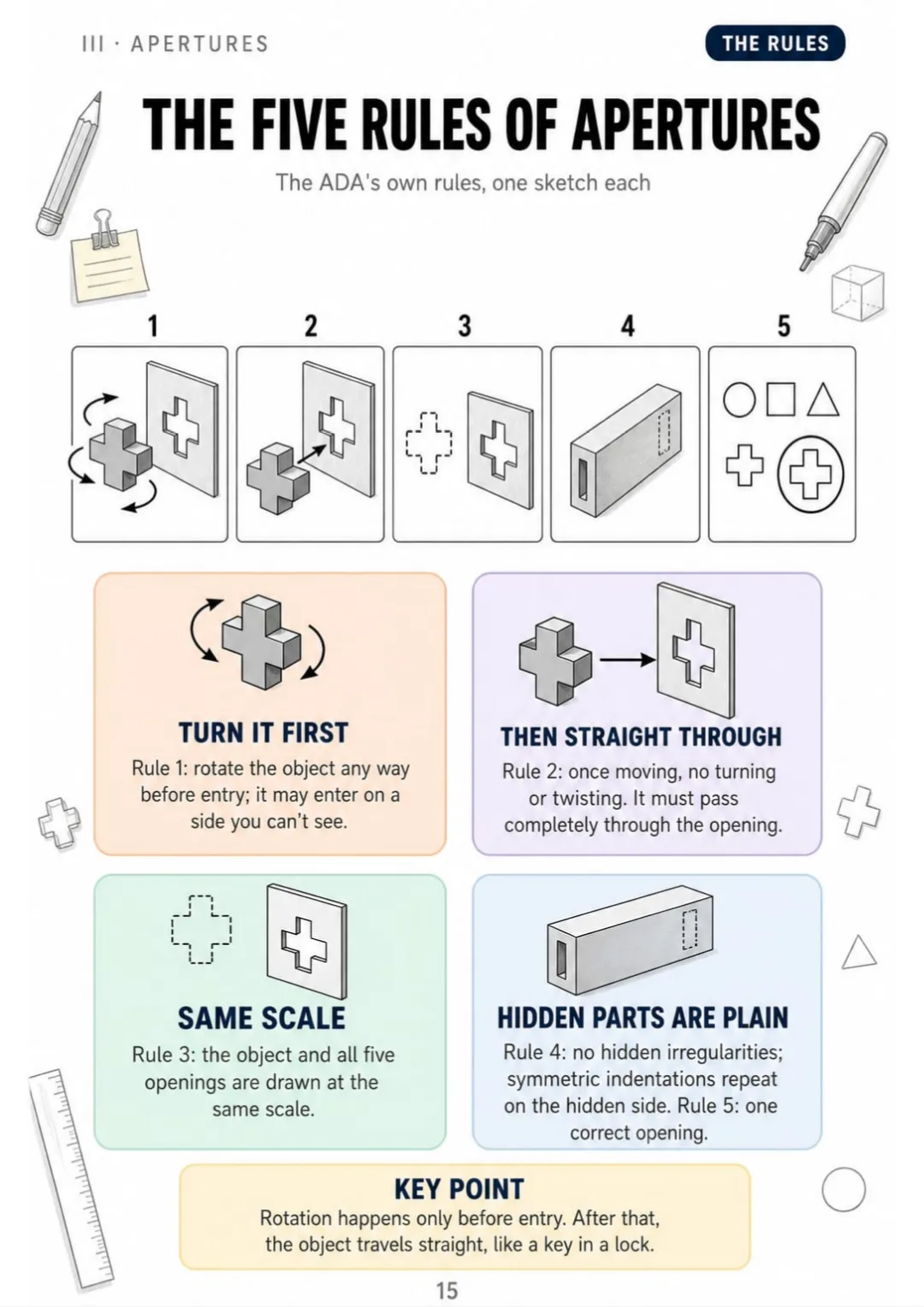
Here, apertures are one page: five rules, one sketch each, from "rotate first" to "straight through," all drawn at the same scale.
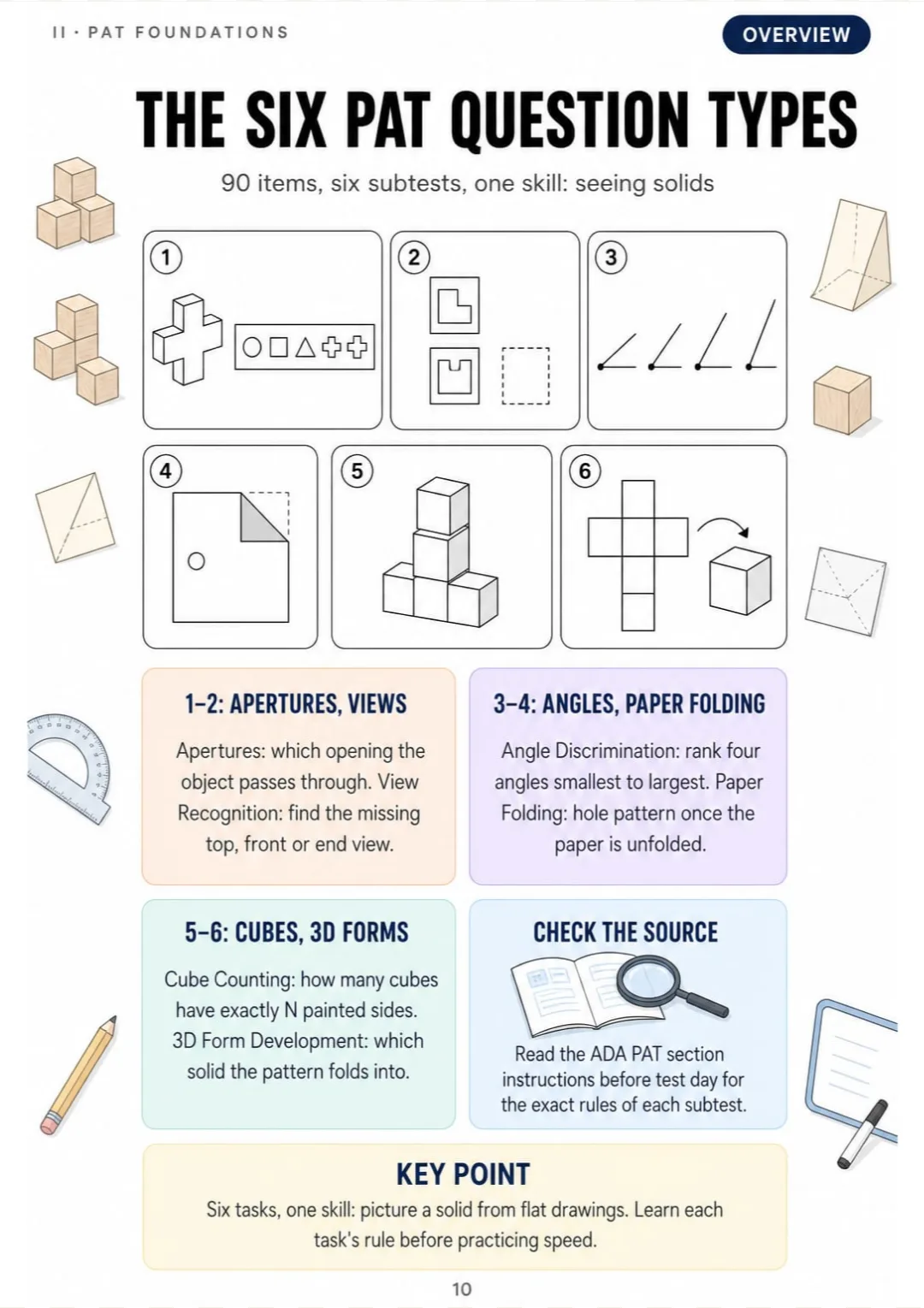
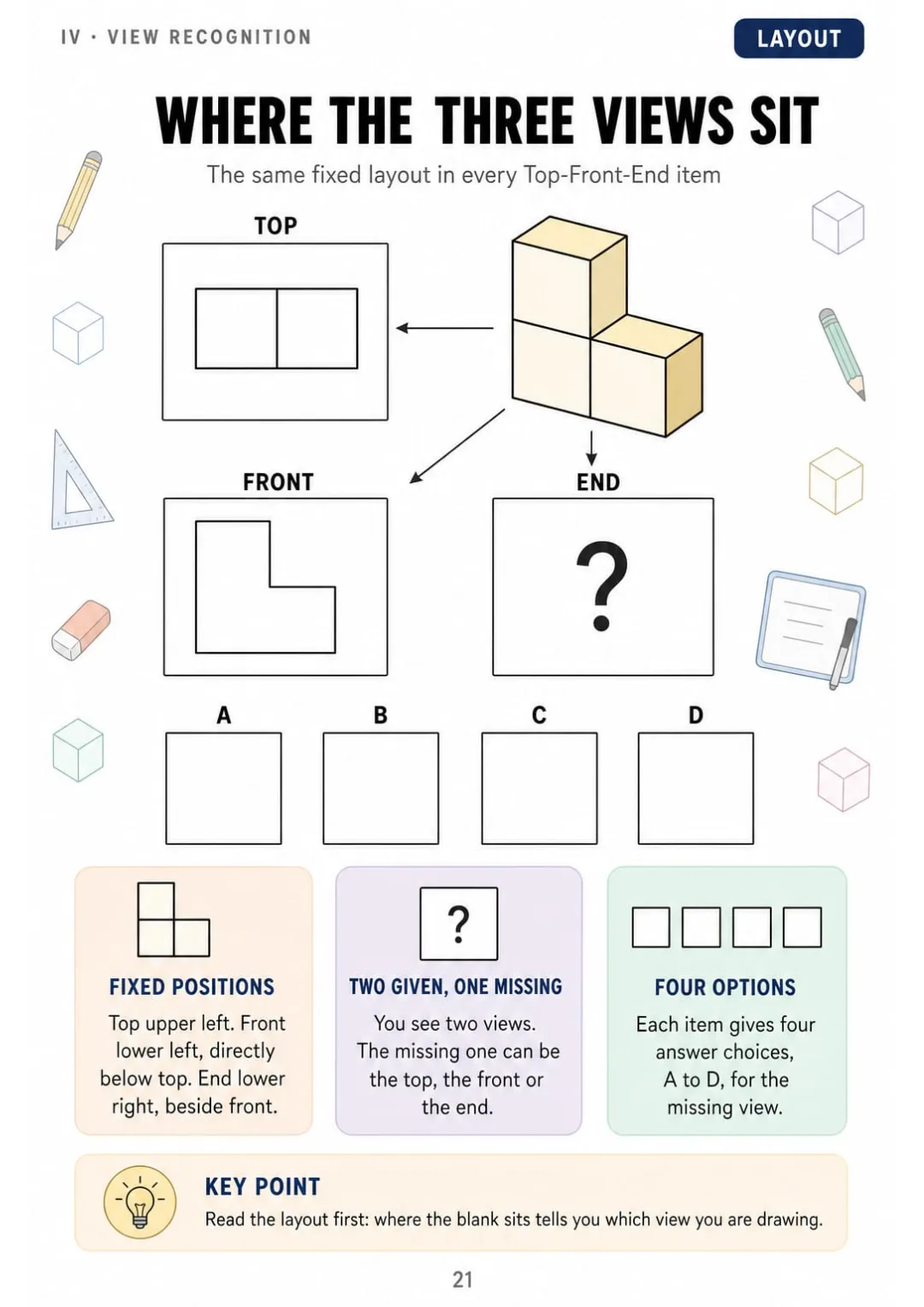
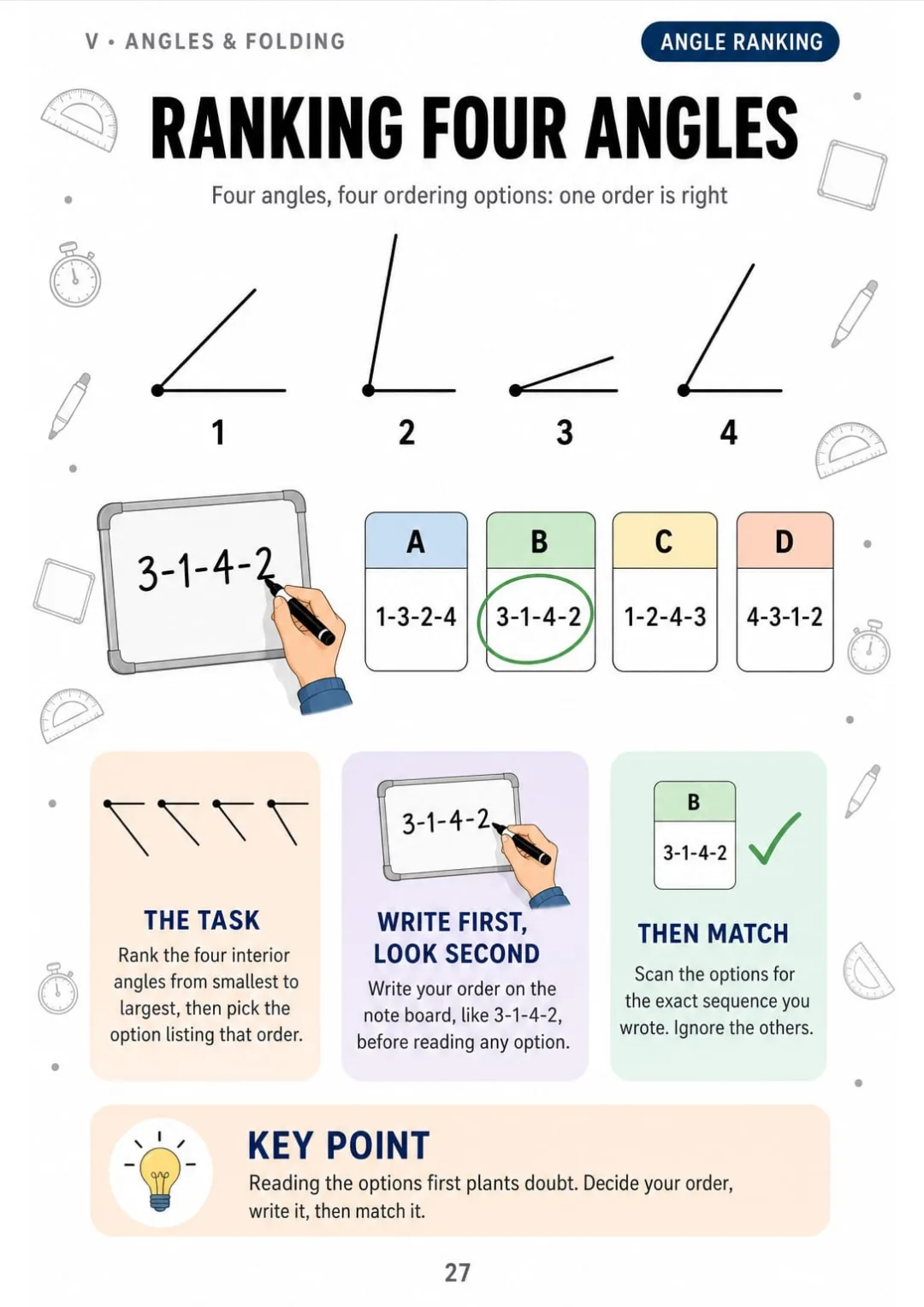
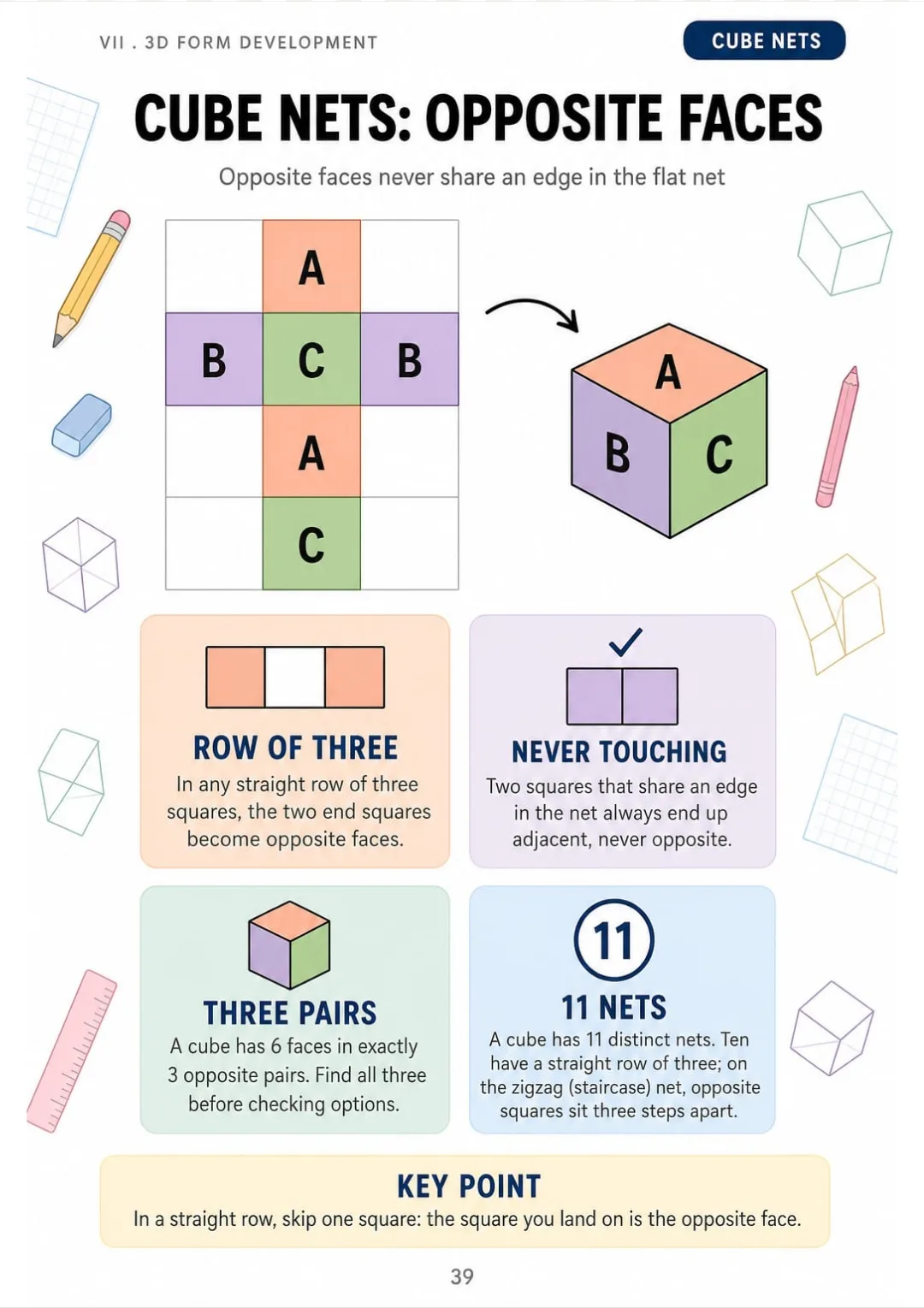
And on the pages next to it, every subtest gets its own: top-front-end views, angle ranking, paper folding, cube counting and cube nets.
First you understand why it works that way. Then the order sticks on its own.

The DAT and its PAT, PAT foundations, apertures, top-front-end views, angles and paper folding, cube counting, 3D form development, biology, general and organic chemistry, reading and quantitative reasoning, and review and test day: 65 pages, all drawn
What if every DAT topic fit on a single page?
Instead of rereading half a page on cube counting without being able to see it...
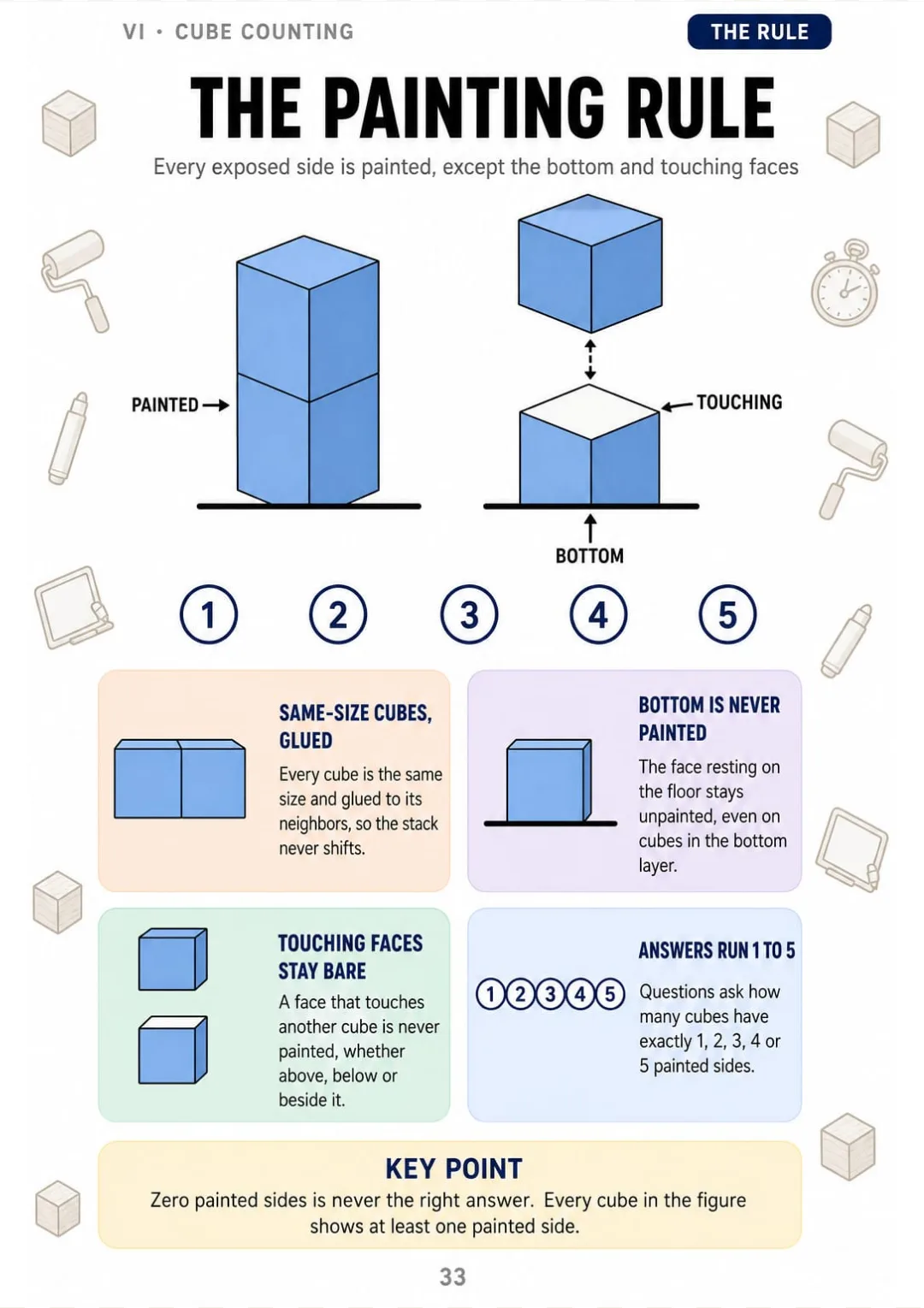
...you open the page and find the stack drawn column by column, with the painting rule in a box and a tally table for one, two and three painted faces.

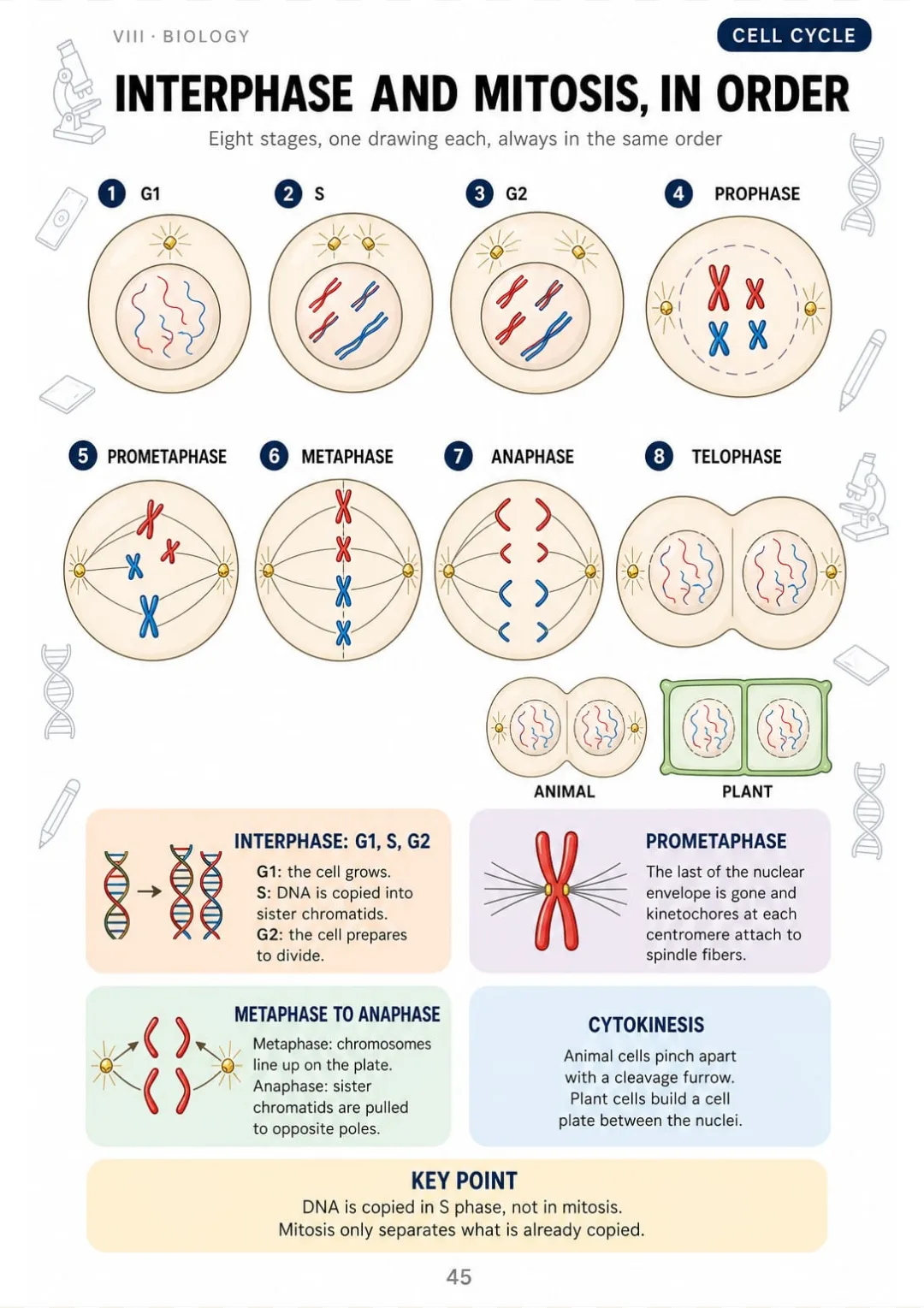
And apertures, top-front-end views, cube nets, mitosis and SN1/SN2 turn into drawings and tables you can read at a glance.
You stop rereading and start understanding.
That's exactly what The DAT Sketchbook does. It's not “just another prep book.” It's 11 parts and 61 drawn topics, with worked examples for every PAT subtest and, at the end, a page of PAT mistakes by subtest. Because what your brain sees in order, it remembers.
Because what your brain sees organized, it remembers.
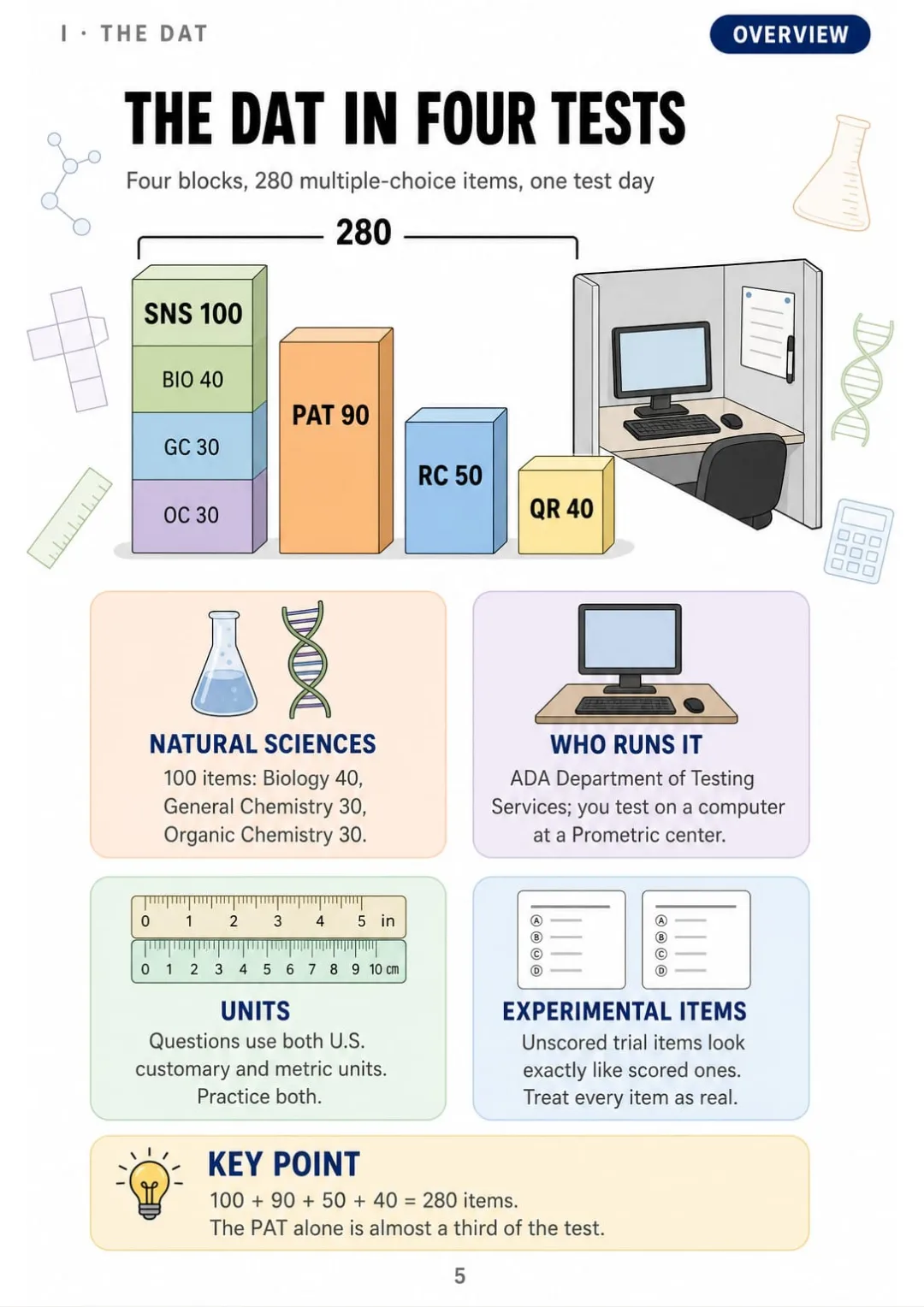
Know the whole test before you study it: the four DAT tests and their 280 items, the 5-hour-15-minute test day, the 200–600 score scale, fees, retest rules and the Canadian DAT.
The six PAT question types, pacing 90 items in 60 minutes, faces, edges and vertices, orthographic views and mirror images.
The five aperture rules, an object's three silhouettes, hidden sides, right shape but wrong size, and a keyhole item worked from scratch.
Where top, front and end views sit, solid vs dotted lines, matching edges, holes, slopes and notches, and a full item worked from scratch.
Ranking four angles, near-equal angles, dashed vs solid fold lines, unfolding backward, counting layers and diagonal folds.
Count any stack the same way, every time: the painting rule, hidden support cubes, top, edge and corner positions, a tally table, a full stack and the classic miscounts.
Cube nets and opposite faces, edges that meet, shaded faces through a fold, prism and pyramid nets, and ruling out impossible shapes.
Interphase and mitosis, meiosis I vs II, monohybrid and dihybrid crosses, germ layers and blood flow through the heart.
The mole and the gas laws, pH and Kw, functional groups, SN1/SN2/E1/E2 in one table, Zaitsev's rule, curved arrows and R/S.
The reading section in three passages, mapping a science passage, the QR content map, probability rules and ratios.
PAT mistakes by subtest, warm-ups for the note boards, science look-alike terms, check-in and breaks, and scores and retesting.
At the end of the book: Worked examples for every PAT subtest and a page of PAT mistakes by subtest.
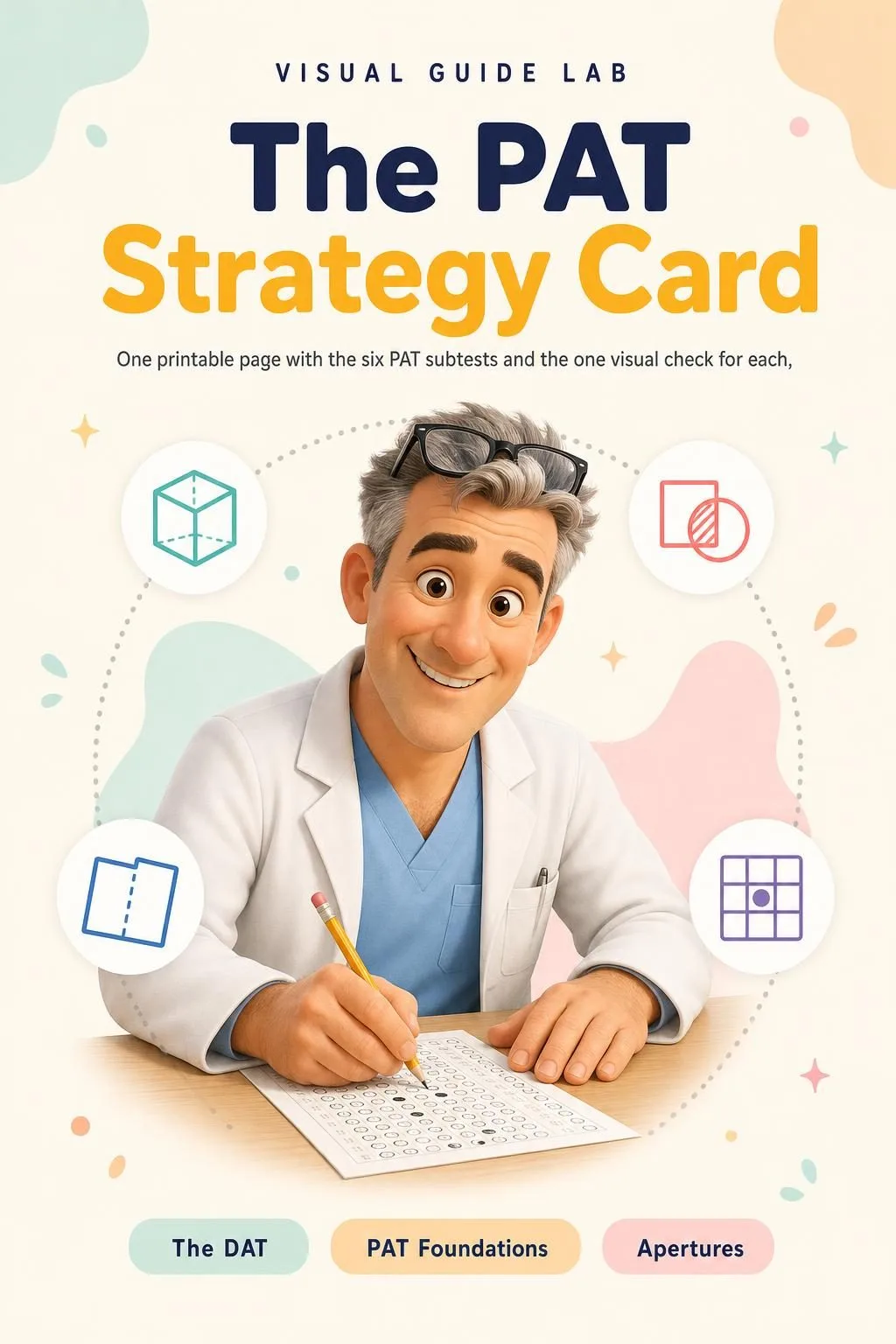
One printable page with the six PAT subtests and the one visual check for each, so your last review before test day fits on a single sheet.

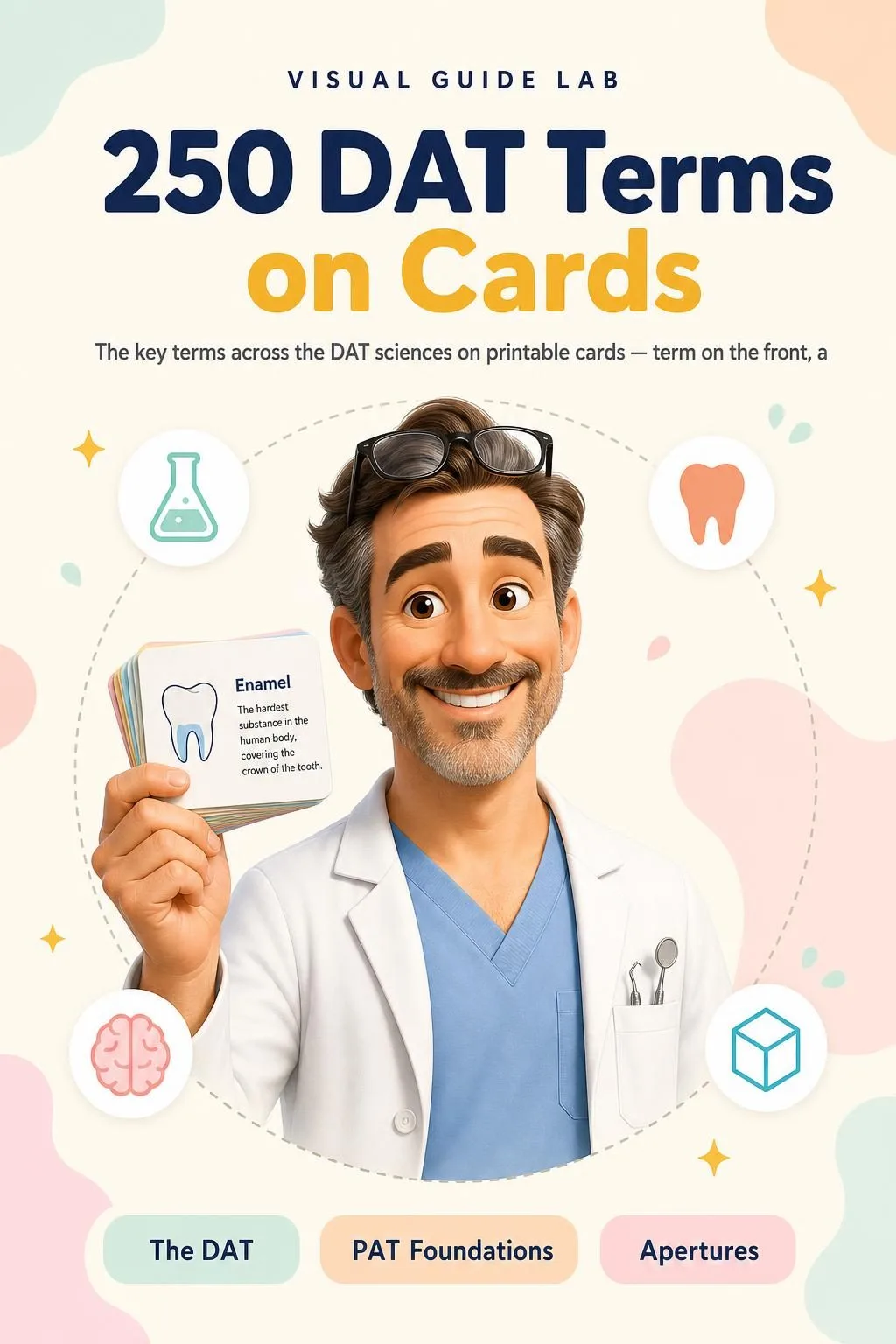
The key terms across the DAT sciences on printable cards — term on the front, a one-line definition and a tiny sketch on the back — to review frequent mix-ups in short sessions.
📄 This is a digital PDF book sent to your email: nothing is printed or shipped.
PDF by email: The DAT Sketchbook reaches your inbox as a PDF, and the two free books come by email too. One-time payment, no installments or hidden costs.
The six PAT subtests drawn step by step, plus biology and chemistry one page at a time, to review between classes and labs.
One fixed check for each PAT subtest, worked examples from scratch and a page of the most frequent mistakes, to review the whole test in order.
If you're an assistant or hygienist moving toward dental school, a visual review that fits around your shifts: one topic per page, ready to print.
📄 This is a digital PDF book sent to your email: nothing is printed or shipped.
30-day guarantee: tell us what didn't work and we'll refund 100%.
You have 30 days to try The DAT Sketchbook and the two bonus books. If it doesn't work for you, tell us what didn't work and we'll refund 100% of what you paid. One-time payment, no subscriptions.
You get The DAT Sketchbook as a high-resolution PDF by email, at the address you enter at checkout, to read on your phone or print. The two bonus books come by email too: The PAT Strategy Card, with the six PAT checks in short form to keep next to you while you drill, and 250 DAT Terms on Cards, science terms in flashcard format to print and cut.
A one-time payment of US$ 37. No installments, no subscription.
For anyone preparing for the U.S. DAT: pre-dental students, graduates who work and study at night, career changers like dental assistants and hygienists, and people retaking the test. Each dental school sets its own requirements. Check the table of contents above to see every topic.
It's built for the 2026 DAT. The PAT and test-day pages follow the ADA DAT 2026 Candidate Guide, the ADA Perceptual Ability Test instructions, the DAT User Manual and the ADA notice on 2026 exam changes, including the new 200–600 score scale. The organic chemistry pages were checked against the 2026 ADA content outline. The sciences use OpenStax Biology 2e, Chemistry 2e, Organic Chemistry and Introductory Statistics, and the CDA DAT Candidate Guide is used for the Canadian comparison. Every example is original.
No. It's an independent study book. It isn't affiliated with or endorsed by the American Dental Association or the Canadian Dental Association, and it doesn't copy official questions or figures.
No. It's a visual study aid, not a full course. Six of its 11 parts are the PAT: one drawn check per subtest that you carry into your question bank's drills, so you stop eyeballing. Biology, chemistry, reading and quantitative reasoning get one page per key topic, for review. It doesn't replace your college courses, a prep program or the official ADA instructions.
No. All exam-style examples are written for this book, with their own drawings. They're for practicing the method, not official questions from any exam.
Yes. The PDF is made to print at home on letter-size paper, the whole book or just the pages you need.
You have 30 days: tell us what didn't work and we'll refund 100% of what you paid.
You don't have to reread the same page hoping it sticks this time.
You don't have to memorize PAT rules you can't picture.
And you definitely don't have to walk into the DAT not knowing where to start.
There's a simpler way. And it's one click away. Now it's your turn.
One-time payment: US$ 37 · Guarantee: 30 days · PDF by email
YES, I WANT THE DAT SKETCHBOOK FOR US$ 37📄 This is a digital PDF book sent to your email: nothing is printed or shipped.